
Baltimore VINELink Custody Coverage
Maryland VINE handles victim information and notices. The service pulls from detention centers, both levels of Maryland courts, the Division of Correction, parole, and probation. No facility-by-facility chart exists. No exact BCBIC upload interval is promised either. Search the record that exists, then confirm critical facts with the agency holding the person.
Baltimore's booking path is odd. DPDS runs Central Booking for anyone arrested in Baltimore City or held on a city warrant. Housing may later shift to BCBIC or another DPSCS facility, and release happens too. VINELink can catch some of these moves. It is not the police arrest report or booking packet, though.
The VINE page names the service and its access channels.
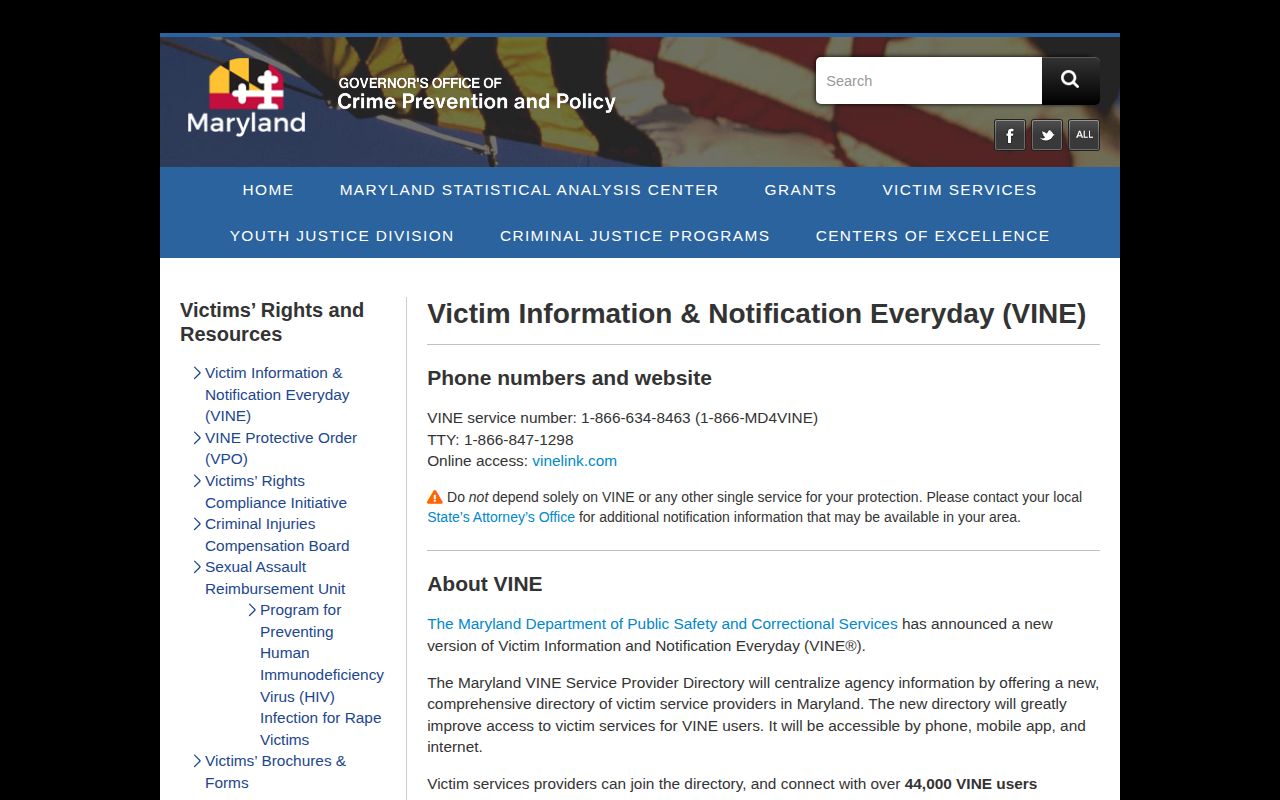
Start at the state page whenever an app route or vendor link shifts.
Search Baltimore VINELink Records
Enter a full name and any identifying number. VINELink's screens change over time. Reach the service through the official state page or the main portal rather than a saved side door. What comes back is a custody or court status record, not the full story of a case.
- Open VINELink and select Maryland.
- Choose the available person or case search and enter a name or identification or case number.
- Compare all returned matches. Use available identifiers and facility or case details before choosing one.
- Open the record and note the displayed custody, court, or supervision status.
- Confirm a critical release or transfer directly with the listed agency because data transmission can lag.
The state-selection screen is a plain search entry point.

Selecting Maryland matters because similarly named systems and records can exist in other states.
Baltimore VINELink Result Fields
What shows up depends on the record. Maryland materials describe custody changes like release, transfer, or escape, plus court events such as upcoming hearings. A result may also carry an identifier or location that helps separate similar matches. It is not a charge-history database or booking-photo roster.
| Possible result | How to use it |
|---|---|
| Name or record identifier | Compare it with known details before registering |
| Custody status | Shows the available status, subject to reporting delay |
| Facility or agency | Identifies where to confirm current custody |
| Release or transfer event | Signals a change, not a permanent history |
| Court event | May include available hearing information |
| Not provided as a gallery | VINELink is not a Baltimore booking-photo feed |
Custody answers shift over time. Save the relevant agency contact and court case number instead of treating a screenshot as permanent proof.
Register Baltimore Custody Alerts
Registration starts from the right person or case record. Options can vary. Maryland VINE may offer phone, text, email, in-app, or TTY notices, and the free, confidential service is still no safety guarantee.
- Select the notification option on the matched record.
- Choose an offered delivery method and enter current contact information.
- Create the required four-digit PIN for a phone registration. Email registration does not require a PIN.
- Respond to a phone alert with the PIN to stop repeat calls.
- Register more than one phone number or email address where the interface permits it.
Keep every number and address current. A notice cannot reach a disconnected phone or an abandoned email, and Maryland's official VINE page lists 1-866-634-8463 and TTY 1-866-847-1298 for help.
Re-register After Baltimore Transfers
Maryland VINE folds several notice types into one service. Registrations do not always follow a case through every change. State guidance says to register again when a case moves from District Court to Circuit Court, or when a person moves from local detention into state prison, and that rule is Baltimore's assigned VINE distinction.
A transfer is not a release. Responsibility may simply shift from Central Booking to another DPSCS institution. Open the new record. Check its identifiers. Create a fresh alert registration if the old one does not carry over.
Baltimore VINELink Search Limits
A brand-new arrest may not appear at once. No source promises every BCBIC booking enters VINE. No exact upload delay is published either. For very recent events, try the Baltimore arrests last 24 hours roundup, call the appropriate facility for custody questions, and use BPD or DPSCS records channels for the arrest packet.
VINELink does not replace Maryland Case Search. Case Search tracks the final court outcome. VINE sticks to available status and notification events instead.
Federal Custody Uses Other Locators
Federal and immigration custody sit outside this Baltimore booking path. Use the BOP Inmate Locator for federal prison custody. Use ICE's Online Detainee Locator for immigration holds. The DHS-VINE portal documents a separate federal context, and neither tool is a BCBIC arrest roster.
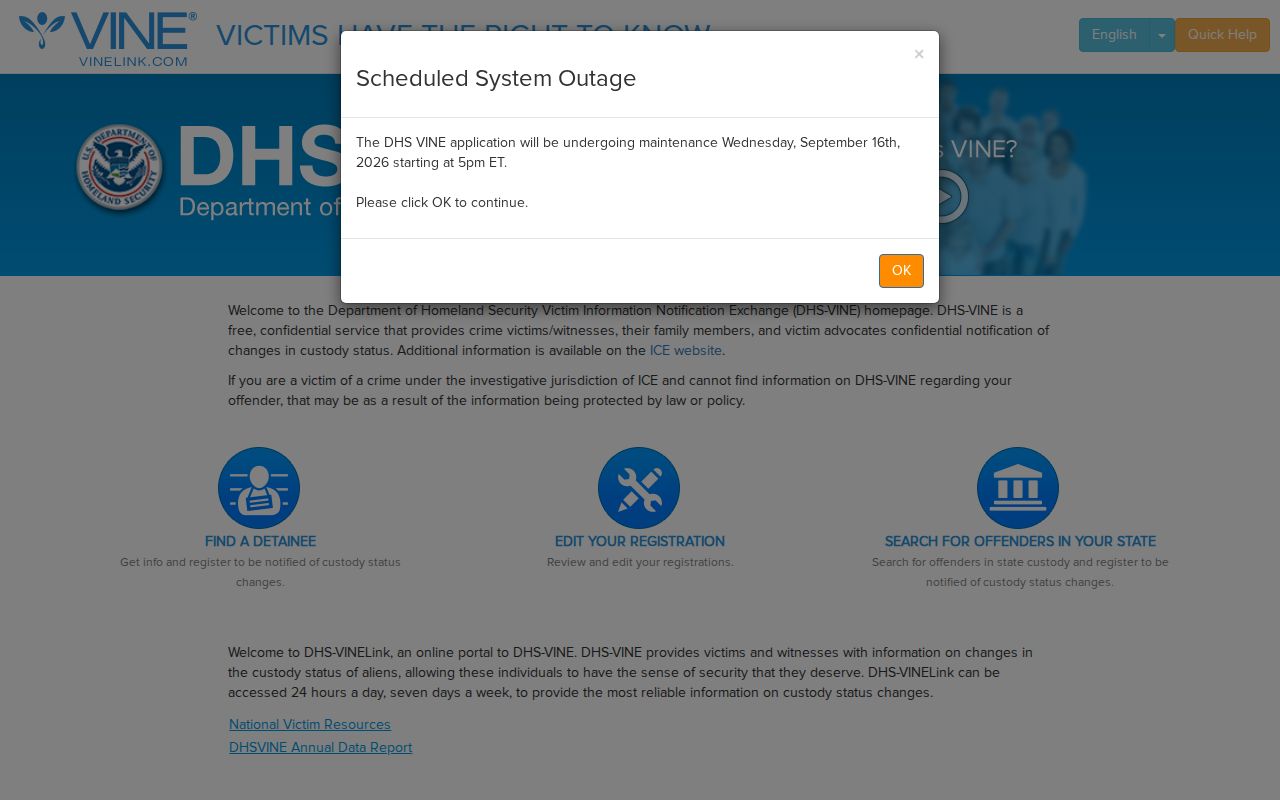
This federal screen says nothing about Central Booking participation.
Baltimore Custody States Explained
Each source answers a different question. Someone just booked may sit in BPD or DPDS records while public updates lag behind. A pretrial detainee is held pending a hearing. A released person can vanish from a locator. Police and court files still exist, and a person sentenced to state custody may surface in the DPSCS locator, though that result is not the arrest record itself.
- Booking
- Administrative intake after arrest, including identity and charge processing.
- Transfer
- A move between facilities or systems, not necessarily a release.
- Disposition
- The court’s final resolution of a charge.
- Notification
- An alert based on an available status event, subject to coverage and timing.
Keeping these terms apart prevents one common error. A "not found" result never proves that no arrest or custody event occurred.
Use Maryland VINE by Phone
Prefer a phone to a browser? Maryland VINE runs there too. The state lists 1-866-634-8463, with a TTY line at 1-866-847-1298. Its brochure says representatives answer the line around the clock, which helps whenever the website is down. Just remember the same limit: a representative reads from VINE records and cannot produce a live BCBIC roster.
Phone registration hinges on a four-digit PIN. Pick digits you can recall that others would not guess. When an automated VINE call comes in, that PIN confirms you got the message and stops repeat calls about the event. Change your phone number? Rebuild the registration. Setting up more than one registration also guards against a disconnected line swallowing a notice.
Baltimore Court Alert Changes
Custody is only part of the picture. Maryland VINE can add court details. This applies when a case appears. It stays handy after an arrest turns into a court matter. It still does not replace the official Judiciary record. District Court and Circuit Court sit at different stages, and cases sometimes move between them. State guidance flags a quirk there: the move may demand a fresh VINE registration.
Turn to Maryland Case Search for public hearings and outcomes. No online summary? A clerk may still hold a public file. Sealed, shielded, expunged, and juvenile matters stay restricted. In the end, a VINE alert reports one event, full stop. It interprets no docket, and it promises nothing about future notices.
Baltimore Alert Safety Planning
Maryland calls VINE confidential and free. It never calls it a safety guarantee. A late call can delay notice. So can a dead device, a changed email, or a missing record. Anyone facing an immediate threat should call 911. For nonemergency questions about notification programs, agency victim-services contacts are the right stop.
DPSCS also separates VINE from its written DOC victim notification. The two are not interchangeable. Anyone counting on formal written notice should follow the agency process on top of VINELink. Keep registration details private. Revisit them after each transfer or court move. Hold onto the correct agency and case contacts.
Maryland's VINE material lists separate pretrial and corrections contacts. Those lines can route a status question. None of them proves a particular Baltimore booking has posted. Give staff the person's full name, any identifier, the facility, and case details. A common-name match is never certain until the identifying facts line up.
What if an alert clashes with a docket or a facility statement? Note the time on each source, since status systems update in sequence. Then contact the agency behind the newest official record. Ask whether the event was a release, a transfer, a court movement, or a data correction. That distinction can decide where a person actually is right now.